


Resources
Before Wildfire Strikes: A Guide to Improving Wildfire Preparedness and Living with Fire in Hood River County
This guide will help you:
Increase the chances that your home survives a wildfire through practical tips for home hardening and creating defensible space.
Plan for wildfire on your woodland property by implementing management practices like thinning and fuel breaks.
Create an emergency preparedness plan for your family.
Prepare for wildfire smoke by monitoring air quality and improving your home’s indoor air.
Explore how wildfires have shaped the Hood River landscape and learn about collaborative efforts to improve wildfire resilience in Hood River County.
The peer-reviewed publication is available in both English and Spanish. You can read it online and download a copy here.
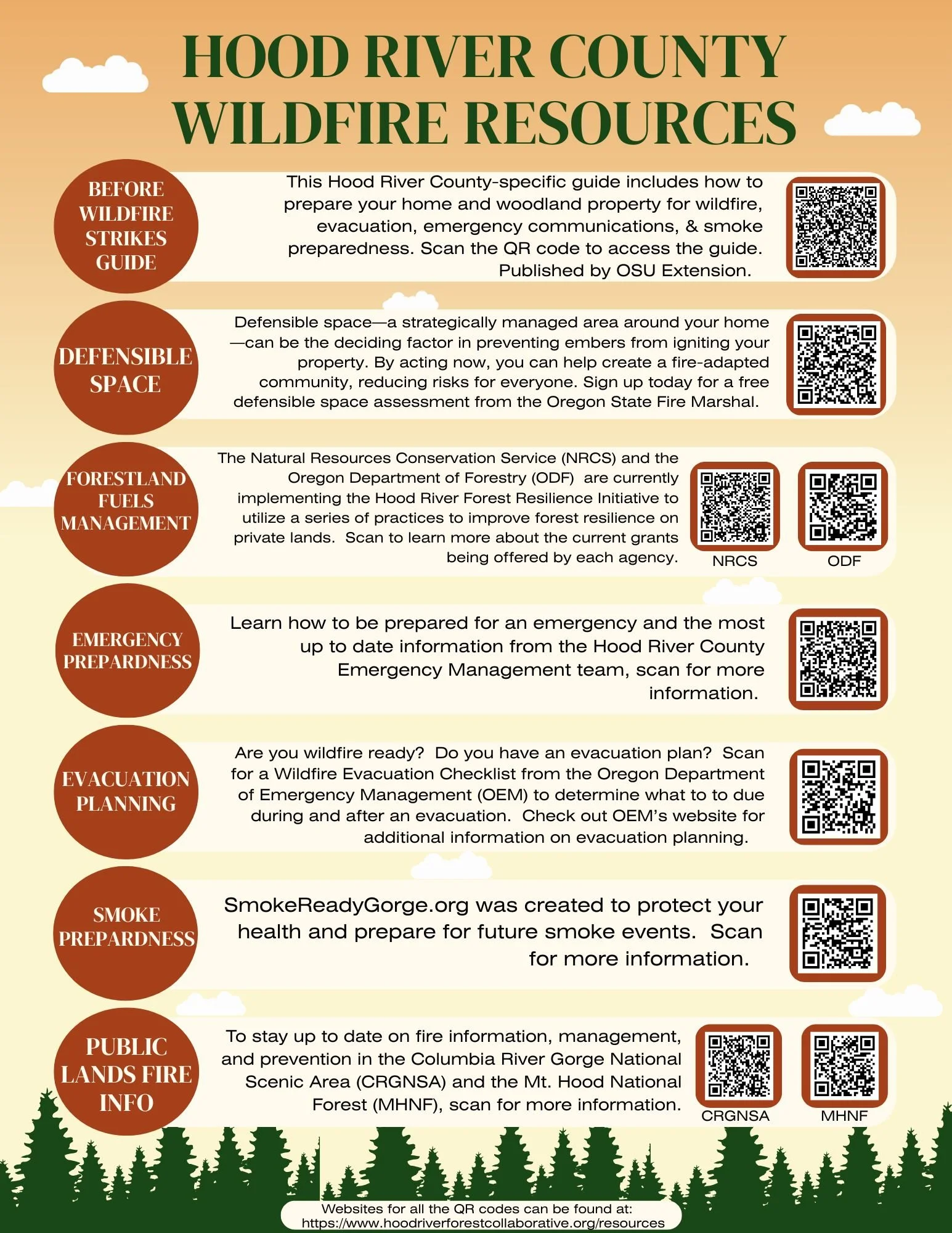
Hood River County Wildfire Resources
This one-page guide includes an overview of relevant partner organizations and resources to help prepare for wildfire - from defensible space and fuels management to evacuation planning and smoke preparedness. Product was created by Hood River Soil and Water Conservation District and members of the Hood River All-Lands Partnership. Available in both English and Spanish.
Hood River County Community Wildfire Protection Plan (2025)
Developing a Community Wildfire Protection Plan (CWPP) helps a community clarify and refine its priorities for the protection of life, property, and critical infrastructure in the Wildland–Urban Interface (WUI) on both public and private land.
The mission of the Hood River County CWPP is to decrease the vulnerability of the residents, properties, tribal lands, infrastructure, businesses, and resources of Hood River County by actively promoting mitigation, awareness, preparedness, and response to the negative effects of wildland fires.
Read the plan here.
Mt. Hood Area All-Lands Strategic Action Plan to Reduce Wildfire Risk (2025)
The Mt. Hood area, like much of the American West, is experiencing shifts in ecosystem dynamics due to forest management practices and fire exclusion over the last century, increased human development near fire-dependent forest lands, and more severe wildfires. Taken together, these factors have increased wildfire risk across the Mt. Hood area. This area ranks high in both state (Oregon Landscape Resiliency Strategy 2023) and national (Wildfire Crisis Strategy 2022) risk assessments, demonstrating the urgent need for proactive wildfire risk reduction to support resilient communities and landscapes. Tribal Nations, leaders in landscape resilience work, are asking for increased stewardship on ceded lands to promote forest health and resiliency. Partners express that now is the time to think strategically and collaboratively about managing shared risk. This collective plan for wildfire risk reduction builds on the strengths of individual organizations and local partnerships while identifying and addressing shared priorities to achieve the greatest impact across a larger geographic footprint.
Read the full plan here.

Forest Resilience on Private Lands
Natural Resources Conservation Service is currently implementing the Hood River County Forest Resilience Initiative. The initiative focuses on private lands in Hood River County, Oregon and addresses concerns associated with wildfire risk by utilizing a series of practices to improve forest resilience. This initiative has been catalyzed by recent uncharacteristic and catastrophic wildfire events. Although this strategy primarily addresses concerns related to wildfire, objectives are to return systems to their natural structure and composition which will subsequently support ecosystem processes on a holistic level and promote native plant and wildlife species. Learn more here.

East Cascades Oak Partnership
The East Cascades Oak Partnership (ECOP) is a group of people who know and love the Columbia River Gorge and the East Cascades as a place with thriving wildlife, a vibrant economy, and incredible beauty. We recognized the importance of Oregon white oak habitats to our quality of life, to a strong economy, and to the well-being of hundreds of species of plants and wildlife with which we share our home. We are collaborating to leverage resources, share knowledge, and implement conservation strategies that will help protect vulnerable oak habitats, encouraging more sustainable human interactions with these important resources and improving outcomes for people, oaks and wildlife. Learn more here.
Smoke Ready Gorge
In the Columbia River Gorge, the air can be smoky all year. Smoke Ready Gorge was created to protect our health and prepare for future smoke events. Let’s be Smoke Ready together.
Learn more at https://smokereadygorge.org.